


Presenting PPWR to the board: how to win management support

When you present PPWR to the board, a regulatory obligation becomes a concrete leadership question about portfolio, cost, data quality, and execution capability.
Short answer: Management support comes when you present PPWR to the board and make the impact on portfolio, cost, data gaps, and execution capability clear.
Since 2019 in Germany, the dual-system fees for certain packaging have also depended on how well it can be recycled – which makes packaging regulation an immediate cost and steering question, not just a legal topic (German Environment Agency (Umweltbundesamt)). The core answer: management support for the PPWR mainly comes when you show the board concrete effects on portfolio, cost, data gaps, and execution capability. Anyone arguing only with legal text explains obligations – anyone arguing with business consequences creates priority, budget, and decisions.
Presenting PPWR to the board means framing the EU Packaging Regulation as a leadership and steering topic: which packaging is at risk, where is solid data missing, and which material or design decisions affect margin, supply chain, and evidence? That is decisive for sustainability, packaging, and regulatory leads because management backing determines whether PPWR requirements are translated into processes, supplier steering, and product decisions early – or only once deadlines, escalations, and rework are already in the room.
In this article you will see how to structure a board presentation on PPWR so it lands internally: with a clear risk logic, solid cost references, and a realistic picture of your data position. Why this matters is also visible in regulatory practice: the Minimum Standard for measuring recyclability, drafted annually by the ZSVR in agreement with the German Environment Agency (Umweltbundesamt), was published in its 2025 edition on 28 August 2025 – a signal that packaging assessment has long been steered methodically and operationally, not just legally (ZSVR).
TL;DR
- Identify PPWR risks per portfolio and prioritise the packaging with the greatest compliance and cost leverage.
- Quantify the impact on margin, dual-system fees, switch-over cost, and possible extra effort along the supply chain.
- Capture data gaps in material, recyclability, and supplier evidence, and name the consequences for decisions.
- Submit an implementation plan with responsibilities, milestones, and budget so the board can decide bindingly.
- Request a demo if you want to steer packaging data, PPWR checks, and DoC generation centrally.
What does the EU Packaging Regulation (PPWR) mean for your company?
What does the EU Packaging Regulation (PPWR) mean for your company?
PPWR
- Stricter recycling requirements
- Reduction of packaging waste
- Promotion of re-use and circular economy
Management support
- Strategy advice & recommendations
- Implementation planning & process optimisation
- Training & staff awareness
The PPWR moves packaging topics out of the functional department into company-level steering, because it does not only define requirements – it also sets the ecological and labelling conditions under which packaging may be placed on the market at all. That is why it is relevant for the board earlier than many teams assume: not only at the legal review, but already at portfolio decisions, material switches, specifications, and supplier requirements. EU Regulation 2025/40 on EUR-Lex describes requirements for the entire packaging life cycle; Deloitte's view on the PPWR explicitly classifies these obligations as sustainability and labelling requirements with operational impact. For companies, the PPWR is therefore primarily a steering and prioritisation topic.
What matters is the role your company actually plays in the supply chain. Depending on the constellation, obligations may apply as manufacturer, importer, distributor, or fulfilment service provider; this mapping is not a formality – it determines which evidence, processes, and responsibilities have to be built internally. Both the IHK Karlsruhe on the new Packaging Regulation and the IHK Regensburg on the PPWR point this out. In practice, many companies only see the scope once they realise that part of the portfolio can only be cleanly assessed with supplier data, specifications, and a defensible material logic.
Concrete data points
- Data point: since 2019, dual-system fees have also been measured by how well a piece of packaging can be recycled (Recyclability of packaging: Minimum Standard 2025 | German Environment Agency).
- Data point: the 2025 edition of the Minimum Standard was published on 28 August 2025 (Minimum Standard for recyclable packaging).
- Data point: the final version of the 2025 Minimum Standard was to be published on 29 August 2025 in agreement with the German Environment Agency in a new structure (Consultation procedure on the 2025 Minimum Standard).
- Data point: the online seminar "Ready for PPWR? Packaging design for the whole value chain" takes place on 15 April 2026, from 10:00 to 12:00 (Fraunhofer CCPE compact: PPWR – Fraunhofer IVV).
Which information actually convinces the board?
Which information actually convinces the board?
Presenting PPWR to the board
- Clear facts & data
- Strategic relevance
- Cost & savings potential
- Legal risks & opportunities
Management support
- Clear recommendations
- Implementation plans
- Define responsibilities
- Expected outcomes
Boards do not decide on the most complete regulatory overview – they decide on the best escalation logic. A PPWR submission only becomes convincing when it turns requirements into a defensible decision question: which packaging is affected, where do execution risks arise, which resources get tied up, and what are the consequences of inaction for portfolio, evidence, or market access. Regulation 2025/40 defines the requirements for the full packaging life cycle and for placing it on the market, but for management this only turns into priority once you add the operational consequence per packaging type (EUR-Lex, Regulation (EU) 2025/40, DIHK information sheet on the PPWR).
Three core slides work in practice. First, risk to portfolio and market access. Show not only "which article falls under which obligation," but which SKUs, formats, or material combinations are likely to become critical and which decisions therefore have to be pulled forward. Second, cost and resource impact. This is not only about possible material or system cost, but internal effort in procurement, packaging development, quality, regulatory, and supplier management. Third, data gaps. This point is often underestimated, even though future evidence depends on solid packaging data; the 2025 Minimum Standard now bundles its measurement specifications along PPWR packaging categories, which makes requirements clearer but also more data-intensive (ZSVR, consultation on the 2025 Minimum Standard, verpackungsgesetz.com, reading version of the PPWR).
Separating facts, assumptions, and open points is decisive. Many teams lose credibility because they present half-finished Excel lists as secured evidence, or, conversely, only show abstract risks. A simpler management logic works better: confirmed exposure, plausible assumptions that need a decision, and concrete data gaps with the resulting impact on release, documentation, or supplier steering. Paragraphs explain the obligation; priority emerges only when it becomes visible which business decision stays blocked without further clarification (DIHK information sheet on the PPWR, Fraunhofer IML on PPWR support).
Quick comparison: paragraphs versus management logic
The practical difference is simple: paragraphs answer "why do we have to act?", management logic answers "why now, where first, and with which resources?". Exactly this translation raises priority inside the company, because it converts legal requirements into portfolio risk, release effort, and data acquisition. The DIHK information sheet on Regulation 2025/40 maps the obligations along affected actors and topics; for the board, condense only the consequences from it – for example affected SKU groups, required specification changes, and missing supplier data (DIHK information sheet on Packaging Regulation 2025/40, ZSVR, consultation on the 2025 Minimum Standard). Presenting this way moves the discussion from "compliance some day" to "decision on sequence, budget, and responsibility now."
How do you build management buy-in for the PPWR?
Management buy-in for the PPWR comes when the regulation turns into a concrete decision paper with priorities, owners, and a timeline. Only when it is clear which decisions are due now and which resources they require can management commit. That requires a structured submission rather than a purely technical briefing.
- Limit the scope. Choose deliberately one product group, one market, or one packaging type. That prevents the board from discussing "all packaging" and therefore prioritising nothing. This limitation is substantively defensible because the PPWR triggers different obligations depending on the role in the supply chain and the packaging type; case-by-case national assessments remain relevant (Deloitte Germany on supply-chain role logic, IHK Regensburg on case-by-case obligation mapping).
- One page instead of 30 slides. For the chosen scope, summarise five points: exposure, data on hand, missing data, business consequences, and decision options.
- Ask for a decision. Don't ask for "feedback" – ask for three approvals: budget, named ownership, and a timeline for structured packaging data collection. The board only prioritises in earnest when it has to choose between options. The useful order is relevance, risk, solution: first show which packaging is affected, then what consequences data gaps have, and only then which organisational or systemic response should be decided today. That turns PPWR communication into a steering process with clear ownership instead of another compliance presentation (Verpackungsgesetz.com on the PPWR reading version and implementation references, Verpackungsgesetz.com on the new EU Packaging Regulation 2025).
Why does PPWR support often fail because of data gaps?
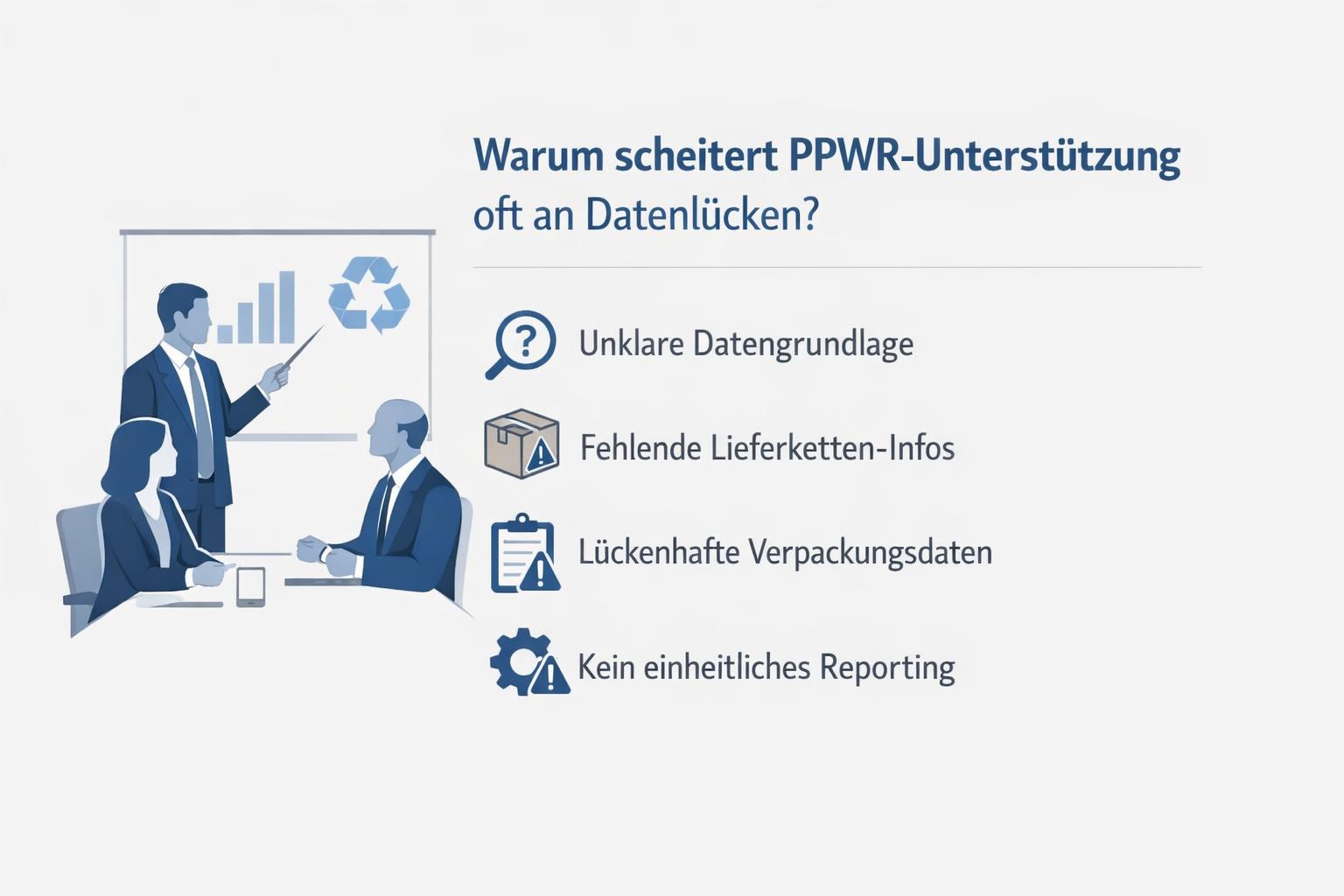
- Treat data gaps as a business risk, not a master-data problem. Without solid data on material build-up, weights, components, labels, adhesives, or recyclate shares, the board can neither cleanly scope which packaging to prioritise nor know which measures are defensible. In practice, many teams see that the PPWR logic is understood internally, but the discussion tips over as soon as it becomes unclear which data is actually available from procurement, product development, and suppliers. The regulation then feels postponable because its effect on portfolio and decision-making capability can't be shown concretely. That is why a data gap quickly becomes a steering problem, as the IHK Karlsruhe on the systematic adaptation of packaging processes and the DIHK information sheet on the PPWR both make clear.
- Test recyclability against real practice, not lab logic. The often underestimated point: the Minimum Standard does not assess whether a piece of packaging could theoretically be recovered in some way, but whether it is actually captured in real sorting and recovery practice and routed into material recycling. The Central Agency Packaging Register (ZSVR) states explicitly for the 2025 edition that theoretical recoverability is not enough and that the methodology is based on the real practice of sorting and recovery (ZSVR Minimum Standard); the German Environment Agency (Umweltbundesamt) also frames the Minimum Standard as the methodical basis for measuring recyclability. For management, this means: assumptions without solid specification data are not conservative – they are potentially wrong.
- Treat missing supplier data as an evidence risk. When suppliers only deliver general material information, the data needed for technical documentation, internal release, and defensible decisions is often missing later. The fact that PPWR requirements affect the entire packaging life cycle and are tied to placing on the market makes this evidence capability particularly relevant (EU Regulation 2025/40 via EUR-Lex); at the same time, Fraunhofer CCPE points to the added requirements on material choice, recyclability, and resource efficiency.
- Translate the data position into defensible board decisions. The board does not need perfect data depth for every SKU, but a defensible view on which packaging can be assessed, where assumptions are in use, and which decisions therefore cannot be cleanly backed today. Only then does it become visible that missing data does not only create uncertainty but blocks the ability to set priorities and justify later decisions to auditors, customers, or internal bodies. That is exactly where support often fails: not at the regulation itself, but at no one being able to prove what is concretely affected and how solid the proposed measures really are.
Conclusion
The PPWR becomes a board topic when you talk about concrete consequences for portfolio, cost, data quality, and deliverability. Prioritise the packaging with the greatest risk, quantify the financial and operational impact, and submit a clear implementation plan with named owners.
To present PPWR to the board, bundle the risks, priorities, and the concrete decision needs into a compact decision overview.
Want to show the board which packaging is affected, where data gaps sit, and what budget the next PPWR phase actually needs? With SUSYCHECK you bring packaging data, supplier evidence, and DoC generation into one platform – the board's decision base comes straight out of the operational system.
FAQ
How do I prepare a PPWR board presentation in concrete terms?
Start with a one-page decision overview that summarises the main packaging risks, the affected portfolio, and the required decisions. Add a clear priority by revenue, risk, and effort so the board doesn't have to decide on all packaging at once. It also helps to separate immediate measures, medium-term projects, and items that can only be decided after data validation.
Which KPIs should I show management for the PPWR?
What matters are KPIs that enable a business decision – for example the share of packaging with incomplete master data, expected switch-over cost per portfolio, and potential extra cost from unoptimised packaging. A KPI on supplier coverage is also useful, so it becomes visible how much of the required data is already in place. If possible, add a best, realistic, and worst-case scenario so management understands the range of impact.
How do I argue for a PPWR budget at the board?
A budget is easier to defend when you measure it against avoided risk rather than just project cost. Compare the effort for data preparation, supplier integration, and packaging assessment against the cost of late decisions, manual rework, or wrong material choices. A defensible next step is a pilot phase for the packaging with the highest risk because the benefit can be demonstrated quickly there.